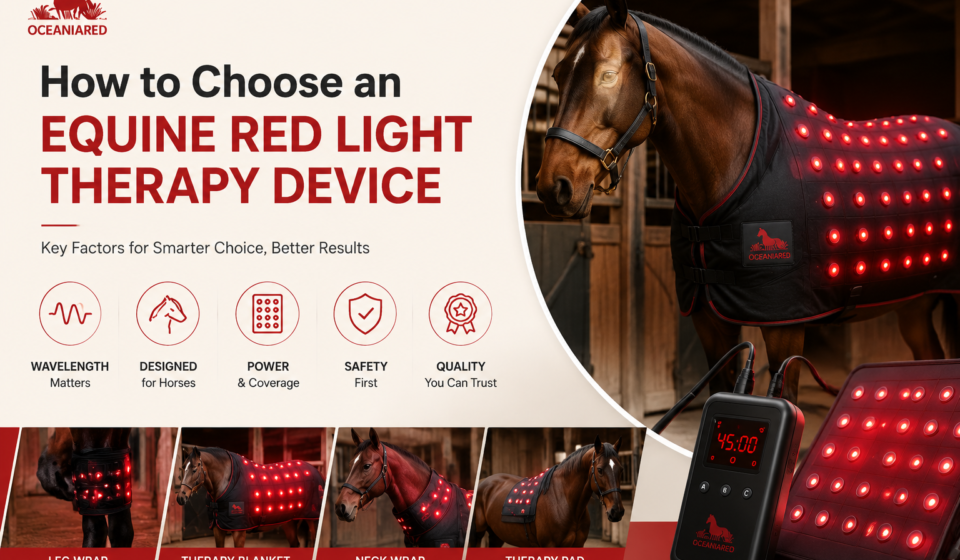

So you’ve decided to explore red light therapy for horses – or perhaps you’re already convinced and ready to find the right device. The good news is that there are more options than ever. The not‑so‑good news? Not all devices are created equal, and the differences matter – especially when it comes to horses.
This guide walks you through the key factors to consider, so you can make an informed choice – whether you’re buying for your own stable or looking to develop a product for your brand.
Why Choosing the Right Device Matters
A poorly designed device can be:
- Ineffective – wrong wavelength or insufficient power means no real benefit.
- Unsafe – overheating, inconsistent output, or poor build quality.
- Impractical – too heavy, hard to use, or unreliable in a stable environment.
On the other hand, a well‑chosen device becomes an invaluable tool – safe, effective, and easy to incorporate into daily care. Here’s what to look for.
1. Wavelength – The Foundation of Therapy
Red light therapy works because specific wavelengths penetrate tissue and trigger cellular responses. Not all wavelengths are equally effective.
| Wavelength Range | Penetration Depth | Best For |
|---|---|---|
| Red (600–700nm) | Shallow (skin, superficial tissues) | Wound healing, skin conditions, surface inflammation |
| Near‑infrared (760–1,400nm) | Deep (muscles, tendons, joints) | Tendon injuries, arthritis, deep muscle recovery |
| Optimal combination | Both shallow + deep | 660nm + 850nm – the most common and effective combo |
What to look for: A device that offers both red (around 660nm) and near‑infrared (around 850nm) wavelengths. This gives you the flexibility to treat both surface and deep tissues.
💡 Tip: Some devices offer switchable wavelengths – great for versatility. Others combine them simultaneously.
2. Power Output (Irradiance) – More Isn’t Always Better, But It Matters
Power output is measured in milliwatts per square centimetre (mW/cm²). This determines how much light energy reaches the tissue in a given time.
| Power Level | Typical Use | Consideration |
|---|---|---|
| Low (< 50 mW/cm²) | Small areas, sensitive skin | Requires longer sessions; may not penetrate deeply enough. |
| Medium (50–200 mW/cm²) | General equine use | Good balance of effectiveness and safety. |
| High (> 200 mW/cm²) | Deep tissue, performance horses | Faster sessions, but must be used carefully to avoid overheating. |
What to look for: A device with sufficient power to penetrate horse tissue – horses have thicker skin and more muscle mass than humans. Aim for at least 50–100 mW/cm² for effective treatment.
⚠️ Important: Power alone isn’t everything. A device with very high power but poor beam uniformity can create hot spots. Look for devices with uniform output across the treatment head.
3. Treatment Area Size – Coverage Matters
Horses have large bodies. A device with a tiny treatment head will take forever to cover a shoulder or hindquarter.
| Treatment Head Size | Best For |
|---|---|
| Small (pencil‑sized or small pad) | Spot treatments, small wounds, acupuncture points |
| Medium (palm‑sized panel) | Tendons, joints, hocks – good for targeted areas |
| Large (flexible pad or large panel) | Backs, shoulders, hindquarters – covers more area in less time |
What to look for: For most equine applications, a medium‑to‑large treatment head is ideal. Flexible pads can be particularly useful for wrapping around legs or draping over the back.
💡 Practical tip: If you’re treating a large area, divide it into overlapping zones and treat each zone separately – even with a larger head, this ensures full coverage.
4. Build Quality and Durability
Horses are strong, stable environments are dusty, and devices get moved around. Your red light device needs to be built to last.
| Feature | Why It Matters |
|---|---|
| Durable casing | Resists bumps and drops. |
| Water‑resistant / dust‑proof | Stable dust, sweat, and occasional splashes won’t damage it. |
| Fray‑resistant cables | Prevents electrical issues over time. |
| Quiet cooling fans | Prevents overheating without startling the horse. |
What to look for: Devices with solid construction, IP rating (water/dust resistance), and reliable components. If you’re developing a product for your brand, ensure your manufacturer offers quality materials and testing.
5. Ease of Use – Practicality in the Stable
A device is only useful if it’s actually used. Consider:
| Feature | What to Look For |
|---|---|
| Weight | Lightweight enough to hold comfortably for 10–15 minutes. |
| Ergonomics | Comfortable grip; easy to position over legs or backs. |
| Controls | Simple, intuitive buttons (not complicated menus). |
| Timer | Auto‑shutoff is a lifesaver – set it and focus on the horse. |
| Battery vs. corded | Battery gives flexibility; corded offers consistent power. Some devices offer both. |
What to look for: A device that feels natural to use. If it’s awkward or confusing, it will end up in the cupboard.
6. Safety Certifications – Non‑Negotiable
A safe device is a must – for horses, handlers, and your peace of mind.
| Certification | What It Covers |
|---|---|
| CE marking | Conforms to European health, safety, and environmental standards. |
| FCC | Electromagnetic interference compliance (for the US). |
| RoHS | Restriction of hazardous substances. |
| Medical device certifications | If you’re positioning the device for therapeutic claims, higher certifications may be required. |
What to look for: At a minimum, CE and FCC compliance. If you’re an ODM/OEM partner, ensure your manufacturer can provide these certifications for your branded product.
7. Flexibility for ODM/OEM – If You’re Developing Your Own Brand
If you’re reading this as a potential partner, you’ll also want to consider:
| Factor | Why It Matters |
|---|---|
| Customisation options | Can the device be branded with your logo, colours, and packaging? |
| Wavelength selection | Can you choose specific wavelengths to suit your target market? |
| Power settings | Can output be adjusted for different applications? |
| Design flexibility | Can the treatment head shape or size be modified for specific uses? |
| Certification support | Will the manufacturer help you with CE/FCC/RoHS for your branded version? |
| MOQ (Minimum Order Quantity) | Can you start with a small batch and scale up? |
What to look for: A manufacturing partner that is transparent, supportive, and flexible – not just a supplier, but a collaborator.
8. Price – Quality Over Cheap
There’s a wide range of prices for red light devices. While it’s tempting to go for the cheapest option, remember:
- Cheap devices often have weak output, short lifespan, or no real therapeutic effect.
- Mid‑range devices generally offer good value for individual owners.
- Professional‑grade devices are built for heavy use and deliver consistent, effective treatment.
What to look for: A device that offers good value – not necessarily the cheapest or the most expensive, but the one that gives you reliable performance, safety, and durability for your budget.
Quick Comparison Table
| Factor | Low‑End Device | Good Equine Device | Professional/OEM Grade |
|---|---|---|---|
| Wavelength | Single, often unverified | 660nm + 850nm | Customisable wavelengths |
| Power output | < 50 mW/cm² | 50–100 mW/cm² | 100+ mW/cm² with uniform output |
| Treatment head | Small | Medium to large | Flexible pads or large panels |
| Build quality | Plastic, fragile | Durable, water‑resistant | Rugged, IP‑rated |
| Certification | Often none | CE, FCC | CE, FCC, RoHS, medical‑grade if needed |
| Customisation | None | Limited | Full ODM/OEM options |
| Price | Low | Mid‑range | Higher, but value‑driven |
Final Checklist
Before you buy or commit to a product, ask yourself:
- Does it offer both red and near‑infrared wavelengths (ideally 660nm + 850nm)?
- Is the power output sufficient for equine tissue (at least 50 mW/cm²)?
- Is the treatment head large enough for practical use on a horse?
- Is it durable enough for stable conditions?
- Is it easy to use – lightweight, simple controls, auto‑timer?
- Does it have safety certifications (CE, FCC, RoHS)?
- Does it come from a reputable manufacturer with good support?
- If you’re branding it, does the manufacturer offer flexible ODM/OEM options?
For ODM/OEM Partners: We’re Here to Help
Choosing a device is just the first step. If you’re looking to bring your own equine red light therapy product to market, we offer:
- Custom wavelength and power configurations.
- Private labelling and custom packaging.
- Flexible MOQ – start small, grow with confidence.
- Full certification support (CE, FCC, RoHS).
- Technical guidance from prototyping to production.
We’re not just a manufacturer – we’re your partner in creating a product that horse owners will trust and recommend.
Final Thought
Choosing an equine red light therapy device doesn’t have to be complicated. Focus on the fundamentals – wavelength, power, build quality, and safety – and you’ll find a device that truly makes a difference for the horses in your care.
If you’d like to learn more about our devices, discuss customisation, or simply ask a question, we’d love to hear from you. Let’s find the right solution – together. 😊