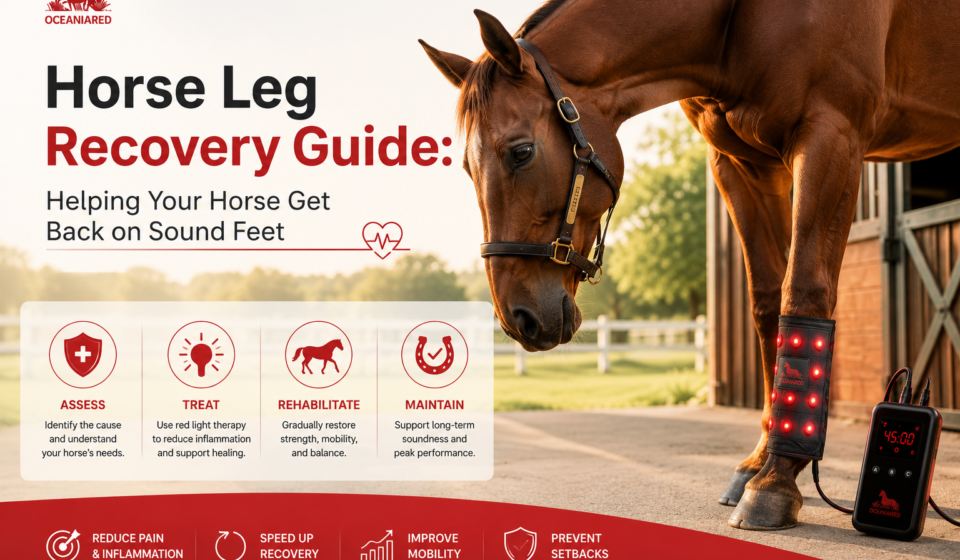

A horse’s legs are its foundation. Whether galloping, jumping, or simply standing in the paddock, those slender limbs carry immense weight and absorb tremendous impact. So when a leg injury occurs, it can feel like the world stops.
This guide covers the most common leg issues, a step‑by‑step recovery roadmap, and how modern tools – especially red light therapy – can support every stage of healing. Whether you’re a trainer, owner, or ODM/OEM partner, we hope this gives you a clear, compassionate path forward.
Why Horse Legs Are So Vulnerable
The equine lower limb is a marvel of engineering – but it’s also a “design compromise.” Long, slender bones, minimal muscle mass, and a limited blood supply make the legs prone to injury and slow to heal.
| Structure | Function | Common Issues |
|---|---|---|
| Tendons (e.g., superficial digital flexor) | Store and release energy for movement | Tendonitis, bows, strains |
| Ligaments (e.g., suspensory) | Support joints and limit excessive motion | Desmitis, sprains, tears |
| Joints (fetlock, knee, hock) | Allow flexion and extension | Osteoarthritis, effusion, chip fractures |
| Bones (cannon, sesamoids) | Bear weight and provide leverage | Stress fractures, bucked shins, fractures |
| Hoof (foot) | Absorb shock and provide traction | Laminitis, abscesses, bruising |
Even minor issues can escalate quickly if not managed correctly.
Common Leg Injuries in Performance Horses
- Tendonitis – inflammation of a tendon, often in the superficial or deep digital flexor.
- Desmitis – ligament inflammation, most commonly in the suspensory ligament.
- Bowed tendon – a visible swelling and bowing of the tendon profile.
- Joint effusion – fluid build‑up in a joint capsule (e.g., “windpuffs”).
- Chip fractures – small bone fragments in joints, usually from high‑impact work.
- Bucked shins – stress reaction on the front of the cannon bone, common in young racehorses.
- Laminitis – inflammation of the hoof laminae; can be triggered by concussion, diet, or systemic illness.
The Three Phases of Leg Recovery
Effective recovery follows a natural biological sequence. Interrupting any phase can delay healing or lead to re‑injury.
Phase 1: Acute (0–7 days)
- Goal: Control inflammation, reduce pain, and prevent further damage.
- Action:
- Immediate veterinary assessment (X‑rays, ultrasound).
- Cold therapy (ice, cold hosing, or ice boots) for 15–20 minutes, 2–3 times daily.
- Strict rest – no weight‑bearing exercise.
- Anti‑inflammatory medication as prescribed.
- Supportive bandaging to minimise swelling.
- Red light therapy role: Begin gentle daily sessions (10–12 minutes) to support early cellular repair after cold therapy. Light helps reduce excessive inflammation while kick‑starting tissue regeneration.
Phase 2: Repair (1–6 weeks)
- Goal: Stimulate collagen production, improve blood flow, and start controlled loading.
- Action:
- Controlled exercise (hand walking, then short lunging sessions as directed).
- Gradual reduction of cold therapy; introduce heat or therapeutic ultrasound if recommended.
- Continue or increase red light therapy to 5–6 sessions per week (8–10 minutes per area).
- Physiotherapy and gentle massage to maintain joint mobility.
- Monitor progress with repeat imaging.
- Red light therapy role: This is where photobiomodulation truly shines – it stimulates fibroblasts (collagen‑producing cells), improves tissue organisation, and reduces scar tissue formation, all of which are critical for tendon and ligament repair.
Phase 3: Remodelling (6 weeks and beyond)
- Goal: Strengthen the healing tissue, restore full function, and prevent re‑injury.
- Action:
- Gradual return to normal work, with regular assessment.
- Maintain red light therapy at 2–3 sessions per week (5–8 minutes) for ongoing support.
- Ongoing physiotherapy and strengthening exercises.
- Careful monitoring for any signs of relapse.
- Red light therapy role: Helps maintain tissue quality, reduces chronic stiffness, and supports the horse’s overall biomechanical balance.
A Step‑by‑Step Daily Recovery Routine
Here’s a sample routine for a horse with a moderate tendon strain, during the repair phase:
| Time | Activity |
|---|---|
| Morning | Remove bandage, assess swelling. Hand walk for 5–10 minutes. |
| Mid‑morning | Red light therapy on the affected area – 10 minutes per site. |
| Afternoon | Controlled walking exercise (as per vet). Cold hose for 15 minutes if any heat or swelling is present. |
| Evening | Red light therapy again (if advised – some protocols use twice daily). |
| Night | Apply supportive bandage (if vet recommends). |
Always adapt to your vet’s advice – every injury is unique.
Red Light Therapy: Why It’s Especially Good for Leg Injuries
Legs have poor blood supply, which makes healing slow. Red light therapy:
- Stimulates new blood vessel growth (angiogenesis), bringing oxygen and nutrients deep into the tissue.
- Boosts ATP production in cells, giving them the energy to repair damage faster.
- Reduces inflammation without the side effects of drugs.
- Promotes organised collagen alignment – this means stronger, more flexible scar tissue, reducing the chance of re‑injury.
- Relieves pain naturally, making the horse more comfortable during rehab.
Practical tips for leg treatments:
- Clean and dry the leg thoroughly – light cannot penetrate through mud or sweat.
- Clip hair if possible (long hair scatters light).
- Divide the area into zones (e.g., upper and lower tendon) and treat each zone separately.
- Hold the device 1–3 cm from the skin (follow product manual).
- Avoid treating directly over open wounds or surgical incisions unless specifically cleared.
Integrating Red Light with Other Therapies
| Method | When to Use | How It Complements Red Light |
|---|---|---|
| Cold therapy | Acute phase, after exercise | Reduces swelling first, then red light promotes repair. |
| Heat therapy | Repair/remodelling phase | Increases blood flow, enhancing red light’s effects. |
| Massage/physio | Throughout rehab | Relaxes muscles, improves lymphatic drainage – red light reduces inflammation so therapy is more comfortable. |
| Controlled exercise | As advised | Maintains joint health; red light helps the tissue adapt to new load. |
| Nutrition | Daily | Red light supports nutrient uptake at the cellular level. |
| Ultrasound / shockwave | As prescribed | These can be combined with red light on alternating days for additional stimulation. |
Preventing Leg Injuries – The Best Recovery
The best recovery is prevention. While you can’t eliminate all risk, you can reduce it significantly:
- Proper conditioning – build fitness gradually; avoid sudden increases in workload.
- Good footing – avoid hard, deep, or uneven surfaces.
- Regular farriery – balanced feet reduce uneven stress on tendons and joints.
- Correct shoeing – use appropriate shoes for the discipline.
- Warm‑up and cool‑down – always include gentle exercise before and after work.
- Regular monitoring – check for heat, swelling, or subtle changes in gait daily.
- Maintenance red light therapy – even when sound, regular sessions (2–3x/week) can keep tissues supple and prevent micro‑trauma from accumulating.
A Note on Patience
Leg injuries test our patience more than almost anything else. Horses may look sound before the tissue is fully healed, and the temptation to push them is strong. But returning to full work too early is the number one cause of re‑injury. Trust the process, follow your vet’s timeline, and use tools like red light therapy to support every step – not to rush it.
For ODM/OEM Partners: Building Solutions for Leg Recovery
Leg injuries are one of the most common reasons horse owners seek therapy devices. This presents a strong, growing market for brands that offer effective, safe, and user‑focused products.
What we can do for you:
- Customise devices specifically for leg applications – flexible pads, targeted heads, and adjustable settings.
- Choose wavelengths – 660nm (superficial) + 850nm (deep penetration) are ideal for tendon and joint work.
- Private labelling – your brand, your packaging, your story.
- Full technical support – from prototyping to certification (CE, FCC, RoHS).
- Flexible MOQ – we welcome small trial batches and scale with you.
We’re not just a manufacturer – we’re your partner in bringing reliable, effective leg recovery solutions to the equine market.
Final Thoughts
A leg injury is never a quick fix, but with the right approach, most horses can return to full function – and often stronger than before. By combining veterinary care, controlled rehabilitation, and modern supportive technologies like red light therapy, you give your horse the best possible chance.
If you’d like to learn more about our devices, discuss customisation, or simply talk about what might work for your brand, we’d love to connect. Let’s help horses heal – one leg at a time. 😊