
Suspensory ligament injuries are among the most common orthopedic problems affecting performance horses. Whether competing in show jumping, dressage, barrel racing, eventing, racing, or endurance riding, horses place enormous stress on their lower limbs every day. Over time, repetitive loading or a single traumatic event can damage the suspensory ligament, leading to pain, lameness, and months of rehabilitation.
Although these injuries can be discouraging, advances in veterinary medicine and equine rehabilitation have greatly improved recovery outcomes.(If you’re looking for a broader overview of tendon-related conditions, you may also enjoy our guide on Red Light Therapy for Horse Tendon Injuries, which explains how light therapy is commonly incorporated into modern equine rehabilitation programs.) Early diagnosis, carefully controlled exercise, appropriate rehabilitation techniques, and supportive therapies all play an important role in helping horses return to work safely.
In this guide, we’ll explain what the suspensory ligament does, why injuries occur, common signs to watch for, available treatment options, and how veterinary-grade red light therapy may complement a comprehensive rehabilitation program.
What Is the Suspensory Ligament?
The suspensory ligament is one of the most important support structures in the horse’s lower limb.
Its primary role is to:
- Support the fetlock joint
- Absorb concussion during movement
- Store elastic energy during exercise
- Prevent excessive extension of the fetlock
- Improve movement efficiency
Without a healthy suspensory ligament, athletic performance becomes difficult and the risk of additional injuries increases significantly.
Because the ligament experiences tremendous force during every stride, especially when jumping or galloping, it is particularly vulnerable to strain.
Forelimb vs Hindlimb Suspensory Injuries
Suspensory injuries may occur in either the front or hind limbs.
Forelimb Injuries
Forelimb suspensory injuries are commonly associated with:
- Racing
- Show jumping
- Eventing
- Polo
- Hunting
The front limbs absorb the majority of impact during landing and high-speed movement.
Hindlimb Injuries
Hind suspensory injuries are especially common in:
- Dressage horses
- Warmbloods
- Collection work
- Reining horses
- Barrel racing horses
Because the hind limbs generate propulsion, repetitive engagement places considerable stress on the ligament.
Common Causes of Suspensory Ligament Injuries
Most suspensory injuries develop through one of two mechanisms:
- Sudden trauma
- Progressive overload
Several contributing factors include:
Intense Athletic Training
Repeated jumping, fast galloping, sharp turns, and powerful acceleration gradually increase ligament stress.
Without adequate recovery time, microscopic damage accumulates.
Poor Arena Footing
Deep sand, slippery footing, frozen ground, and uneven terrain all increase the load placed on the suspensory apparatus.
Consistent footing is essential for injury prevention.
Fatigue
As muscles become tired, they provide less support for the lower limb.
The suspensory ligament must compensate, increasing injury risk.
Improper Conditioning
Horses returning to work too quickly after rest often experience soft tissue injuries because supporting structures are not fully conditioned.
Gradual conditioning is always recommended.
Conformation
Certain horses naturally place greater stress on their suspensory ligaments due to limb conformation.
Although conformation cannot be changed, appropriate management may reduce injury risk.
Aging
As horses age, ligament elasticity gradually decreases.
Senior horses often require longer recovery periods between training sessions.
Clinical Signs of Suspensory Ligament Injury
Some suspensory injuries develop suddenly, while others progress gradually over several weeks.
Common clinical signs include:
Mild to Moderate Lameness
Lameness may initially appear only during strenuous exercise.
As the injury progresses, it may become noticeable at the walk or trot.
Swelling
Localized swelling often develops along the affected ligament.
The amount of swelling varies depending on the severity of the injury.
Heat
Increased warmth around the injured area often indicates active inflammation.
Pain During Palpation
Many horses react when pressure is applied over the suspensory ligament.
Pain may be more obvious immediately after exercise.
Reduced Performance
Performance horses frequently demonstrate subtle signs before obvious lameness appears.
Examples include:
- Reluctance to collect
- Difficulty maintaining impulsion
- Refusing fences
- Shortened stride
- Reduced engagement
- Poor hind limb push-off
Recognizing these early changes allows treatment to begin sooner.
Why Early Diagnosis Matters
Many owners continue exercising horses because the initial signs appear minor.
Unfortunately, continued work often worsens ligament damage.
Small fiber tears can develop into more significant injuries requiring much longer rehabilitation.
Prompt veterinary evaluation offers the best opportunity for a successful recovery.
Veterinary Diagnosis
Accurate diagnosis begins with a complete orthopedic examination.
Veterinarians typically evaluate:
- Gait
- Limb symmetry
- Swelling
- Heat
- Pain response
- Flexion tests
Depending on findings, additional imaging may be recommended.
Ultrasound Examination
Ultrasound remains the most commonly used diagnostic tool for suspensory injuries.
It allows veterinarians to evaluate:
- Fiber alignment
- Lesion size
- Ligament thickness
- Healing progression
Serial ultrasound examinations are often performed throughout rehabilitation.
MRI
MRI provides detailed evaluation of soft tissues and may be recommended for complicated or chronic injuries.
It is particularly useful when ultrasound findings are inconclusive.
Diagnostic Nerve Blocks
In certain cases, veterinarians use nerve blocks to accurately identify the source of lameness before developing a treatment plan.
Treatment Options
Every suspensory injury is unique.
Treatment depends on:
- Severity
- Location
- Duration
- Horse’s athletic goals
- Veterinary assessment
A rehabilitation program may include several components.
Initial Rest
Immediately following diagnosis, reducing exercise is essential.
Rest allows damaged fibers to begin the healing process while minimizing additional strain.
Controlled Exercise
As healing progresses, carefully controlled movement becomes increasingly important.
Walking programs help:
- Improve circulation
- Maintain joint mobility
- Prevent excessive muscle loss
- Encourage healthy tissue remodeling
Exercise intensity should always increase gradually under veterinary supervision.
Anti-Inflammatory Management
Veterinarians may recommend therapies to help manage inflammation during the early stages of recovery.
Treatment plans vary depending on the individual horse and the nature of the injury.
Supportive Bandaging
Supportive wraps may be used during certain stages of rehabilitation to help protect the limb and reduce swelling when appropriate.
Nutritional Support
Proper nutrition provides the building blocks necessary for tissue repair.
A balanced diet containing adequate protein, vitamins, minerals, and hydration supports overall recovery and long-term health.
Why Rehabilitation Takes Time
Ligaments heal more slowly than muscles because they have a relatively limited blood supply.
Even after a horse appears sound, the internal collagen fibers continue remodeling for several months.
Returning to full work too quickly greatly increases the risk of re-injury.
For many horses, complete rehabilitation requires six to twelve months, depending on the severity of the damage and the horse’s discipline.
Building a Long-Term Recovery Plan
Successful rehabilitation focuses on more than simply eliminating lameness.
A comprehensive plan should also aim to:
- Restore normal movement
- Rebuild muscle strength
- Improve flexibility
- Maintain cardiovascular fitness
- Reduce the risk of future injuries
Working closely with a veterinarian, trainer, and rehabilitation specialist provides the best opportunity for a safe and sustainable return to performance.
How Red Light Therapy May Support Suspensory Ligament Recovery
Recovering from a suspensory ligament injury requires more than simply allowing time for healing. The rehabilitation process focuses on restoring healthy movement, rebuilding supporting muscles, and gradually preparing the horse for athletic activity. Alongside veterinary care, many equine rehabilitation professionals now include red light therapy as part of a comprehensive recovery strategy.(To better understand the science behind photobiomodulation and tendon recovery, read our complete guide on Red Light Therapy for Horse Tendon Injuries.)
Red light therapy, also known as photobiomodulation (PBM), uses specific wavelengths of red and near-infrared light to support normal cellular function. Unlike heat therapy, PBM does not rely on raising tissue temperature. Instead, it interacts with cells to support natural biological processes involved in recovery and overall wellness.
Although red light therapy should never replace veterinary diagnosis or treatment, it can be incorporated into a rehabilitation program under professional guidance.
Potential wellness benefits may include:
- Supporting healthy blood circulation
- Helping relax surrounding muscles
- Promoting normal tissue recovery
- Supporting joint flexibility
- Helping horses remain comfortable during rehabilitation
- Complementing controlled exercise and physical therapy
Many owners begin using therapy after the acute inflammatory phase has been assessed by their veterinarian, incorporating sessions alongside daily rehabilitation exercises.
Why Supporting the Entire Limb Matters
A suspensory ligament injury rarely affects only one structure.
When a horse experiences pain in one limb, it often changes the way it moves to avoid discomfort. This compensation can place additional stress on:
- Flexor tendons
- Hock joints
- Fetlock joints
- Back muscles
- Shoulder muscles
- Opposite limb
For this reason, rehabilitation specialists frequently evaluate the horse as a whole rather than focusing exclusively on the injured ligament.
Supporting balanced movement throughout recovery may reduce unnecessary strain on other parts of the body.
Recommended OCEANIARED Therapy Solutions
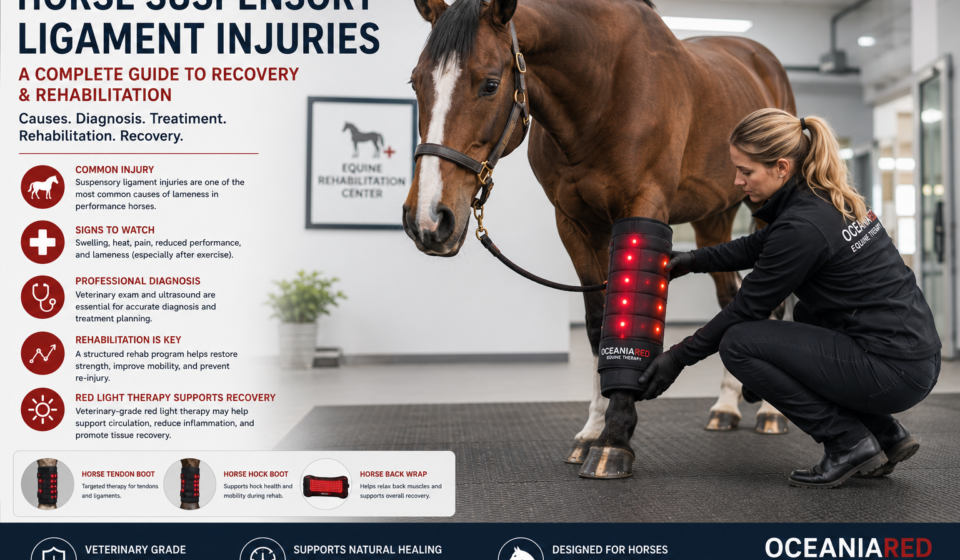
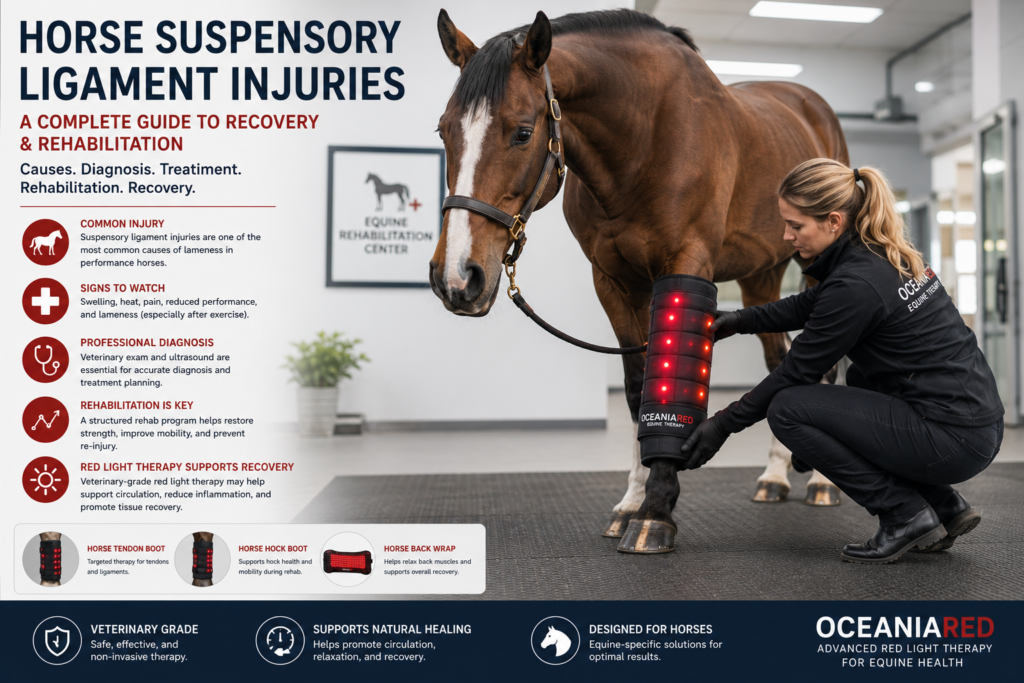
Horse Tendon Boot
The Horse Tendon Boot is designed to deliver targeted red and near-infrared light around the lower limb, making it suitable for rehabilitation programs involving tendon and ligament support.
Common applications include:
- Suspensory ligament rehabilitation
- Tendon recovery
- Daily maintenance
- Post-exercise recovery
Horse Hock Boot
Because many horses alter their movement during recovery, the hocks often experience increased loading.
Supporting the hock region may help maintain comfortable movement throughout rehabilitation.
Horse Back Wrap
Long periods of altered gait frequently lead to muscle tension across the back.
Including back therapy as part of a rehabilitation routine may help maintain flexibility and support overall comfort.
Sample Daily Rehabilitation Routine
Always follow your veterinarian’s recommendations when developing a rehabilitation plan.
Morning
- Observe the horse while walking.
- Check the affected limb for swelling or heat.
- Clean and inspect the lower leg.
- Perform 15–20 minutes of hand walking if approved.
Midday
- Allow adequate rest.
- Provide clean water and quality forage.
- Monitor appetite and general behavior.
Afternoon
- Complete veterinarian-approved rehabilitation exercises.
- Perform gentle stretching if appropriate.
- Apply red light therapy using the Horse Tendon Boot.
- Record observations in a rehabilitation log.
Evening
- Light grooming.
- Recheck the injured limb.
- Ensure comfortable bedding.
- Allow sufficient overnight rest.
Keeping a consistent routine helps monitor progress and allows any changes to be identified early.
Rehabilitation Timeline
Every horse heals at a different pace. The following example illustrates a typical progression but should never replace professional veterinary advice.
Phase 1: Acute Recovery (Weeks 1–2)
Goals:
- Protect the injured ligament
- Control inflammation
- Begin gentle movement if approved
Activities:
- Stall rest
- Hand walking
- Veterinary monitoring
- Supportive therapy
Phase 2: Early Rehabilitation (Weeks 3–8)
Goals:
- Improve circulation
- Maintain muscle condition
- Restore controlled movement
Activities:
- Increased walking
- Pole work when appropriate
- Gentle stretching
- Red light therapy sessions
Phase 3: Progressive Conditioning (Months 2–4)
Goals:
- Rebuild strength
- Improve balance
- Increase endurance
Activities:
- Walking under saddle
- Light trotting
- Hill walking
- Core strengthening exercises
Phase 4: Return to Performance (Months 4–12)
Goals:
- Restore athletic ability
- Prevent re-injury
- Maintain long-term soundness
Activities:
- Progressive conditioning
- Discipline-specific training
- Maintenance therapy
- Regular veterinary re-evaluations
Common Mistakes During Suspensory Rehabilitation
Returning to Work Too Quickly
The horse may appear sound before the ligament has fully remodeled.
Increasing workload prematurely remains one of the leading causes of re-injury.
Ignoring Small Changes
Mild swelling, reduced performance, or subtle gait changes should never be ignored.
Early intervention often leads to better outcomes.
Inconsistent Exercise
Performing rehabilitation exercises irregularly can delay progress.
Short, consistent sessions are generally more beneficial than occasional intensive workouts.
Poor Footing
Deep, uneven, or slippery footing increases stress on healing structures.
Choose safe, level surfaces whenever possible.
Forgetting Overall Fitness
Rehabilitation is not only about the injured ligament.
Maintaining healthy muscles, cardiovascular fitness, and flexibility contributes to a safer return to work.
Frequently Asked Questions
What is the suspensory ligament?
The suspensory ligament is a major support structure in the horse’s lower limb that stabilizes the fetlock joint and stores elastic energy during movement.
Which horses are most at risk?
Performance horses involved in jumping, dressage, racing, barrel racing, eventing, and other demanding disciplines are at higher risk due to repetitive loading.
Can horses recover fully from suspensory ligament injuries?
Many horses return to athletic work with appropriate veterinary care and a structured rehabilitation program. Recovery depends on the severity and location of the injury.
How long does rehabilitation take?
Recovery may range from several months to over a year depending on the horse, injury severity, and discipline.
Is surgery always necessary?
Not always. Treatment options vary and should be determined by a veterinarian based on diagnostic findings.
Can red light therapy replace veterinary treatment?
No. Red light therapy is intended to complement, not replace, professional veterinary diagnosis and treatment.
When can riding resume?
Only after veterinary assessment confirms that the horse is ready to progress to ridden exercise.
Can red light therapy continue after recovery?
Yes. Many owners use maintenance therapy after training sessions or competitions as part of an ongoing wellness routine.
Conclusion
For horse owners interested in learning more about tendon recovery and rehabilitation, we recommend exploring these additional resources:
- Red Light Therapy for Horse Tendon Injurieshttps://oceaniared.com/red-light-therapy-for-horse-tendon-injuries-a-complete-recovery-guide/
- Horse Rehabilitation Exerciseshttps://oceaniared.com/horse-rehabilitation-exercises-a-complete-guide-to-safe-recovery-and-better-performance/
Suspensory ligament injuries can be challenging, but they do not necessarily mark the end of a horse’s athletic career. With early diagnosis, professional veterinary guidance, controlled rehabilitation, and a commitment to gradual progression, many horses return to comfortable work and competition.
Modern rehabilitation emphasizes a holistic approach that includes movement, nutrition, monitoring, and supportive wellness technologies. Veterinary-grade red light therapy has become a valuable component of many rehabilitation programs because it is non-invasive and can be integrated into daily care alongside traditional recovery methods.
Patience, consistency, and evidence-based management remain the keys to long-term success.
Explore OCEANIARED Equine Red Light Therapy
Featured Products
- Horse Tendon Boot
- Horse Hock Boot
- Horse Back Wrap
- Horse Head Wrap
- Horse Hoof Boot
Designed to support equine mobility, recovery, and performance with professional-grade technology.
👉 Discover how OCEANIARED can become part of your horse’s rehabilitation journey.