
Soft tissue injuries are among the most common reasons horses require extended periods of rest and rehabilitation. Whether competing in show jumping, dressage, racing, barrel racing, or eventing, athletic horses place tremendous stress on their tendons and ligaments every day. Although these structures work closely together to support movement, they perform very different functions and respond differently when injured.
Horse owners often hear terms such as “tendon injury” or “ligament injury” used interchangeably. In reality, these injuries affect different tissues, have unique causes, and require individualized rehabilitation plans.
Understanding these differences helps owners recognize problems earlier, communicate more effectively with veterinarians, and make informed decisions during recovery.
If you’re looking for a comprehensive overview of tendon rehabilitation, be sure to read our Red Light Therapy for Horse Tendon Injuries guide, which explains how modern rehabilitation programs often incorporate supportive therapies alongside veterinary treatment.
Understanding Equine Soft Tissue Injuries
The equine musculoskeletal system relies on a complex network of bones, joints, muscles, tendons, and ligaments working together in perfect coordination.
Every stride requires these tissues to absorb impact, generate propulsion, stabilize joints, and maintain balance.
When one structure becomes damaged, the entire movement pattern can change.
This is why tendon injuries frequently place additional stress on ligaments, while ligament injuries often alter tendon loading.
Successful rehabilitation therefore focuses on restoring the function of the entire limb rather than treating a single structure in isolation.
What Is a Tendon?
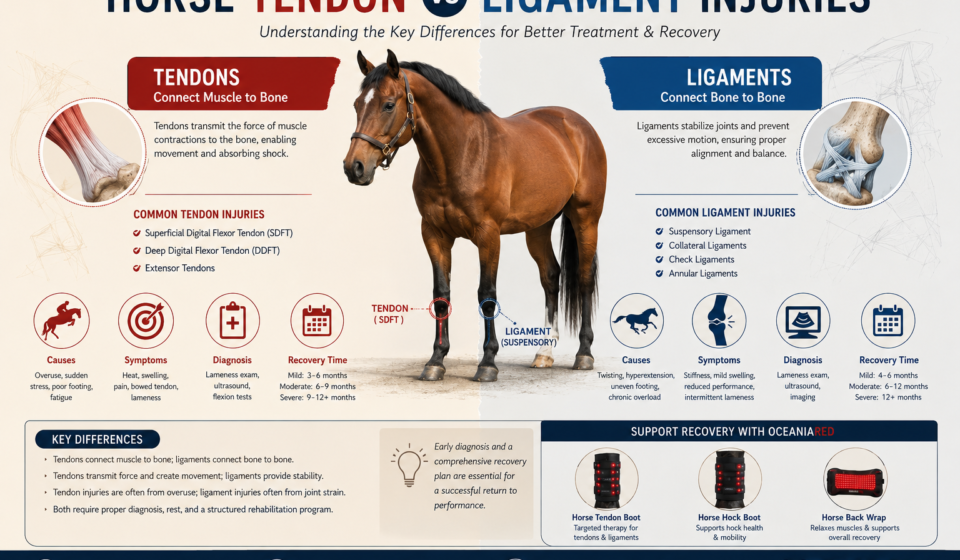
A tendon is a strong band of fibrous connective tissue that connects muscle to bone.
When muscles contract, tendons transmit that force to the skeleton, allowing the horse to move.
Healthy tendons are remarkably strong and elastic, enabling horses to perform powerful athletic movements such as:
- Galloping
- Jumping
- Sliding stops
- Collection
- Rapid acceleration
- Sharp turns
Despite their strength, tendons can become damaged when subjected to repetitive strain or sudden overload.
Major Tendons in the Horse
Several tendons are particularly important in athletic horses.
Superficial Digital Flexor Tendon (SDFT)
The SDFT is one of the most frequently injured tendons in performance horses.
Its responsibilities include:
- Supporting the fetlock
- Storing elastic energy
- Assisting propulsion
- Absorbing shock
Because it stretches significantly during fast movement, it is especially vulnerable to injury.
Deep Digital Flexor Tendon (DDFT)
The DDFT lies beneath the superficial tendon.
Its primary functions include:
- Stabilizing the coffin joint
- Supporting the navicular region
- Assisting limb flexion
- Controlling hoof movement
DDFT injuries commonly affect sport horses, racehorses, and horses with chronic foot pain.
What Is a Ligament?
Unlike tendons, ligaments connect one bone to another.
Rather than producing movement, ligaments stabilize joints and prevent excessive motion.
Without healthy ligaments, joints become unstable and abnormal movement patterns develop.
Common Equine Ligaments
Several important ligaments help maintain limb stability.
These include:
- Suspensory ligament
- Collateral ligaments
- Annular ligaments
- Check ligaments
- Distal sesamoidean ligaments
Each performs a unique role in supporting athletic performance.
The Suspensory Ligament
Among all equine ligaments, the suspensory ligament receives the greatest attention because of its importance in performance horses.
It supports the fetlock during weight bearing while storing elastic energy during movement.
Damage to this ligament often results in prolonged rehabilitation.
If you’d like to learn more about this condition, our detailed article on Horse Suspensory Ligament Injuries explores common causes, rehabilitation strategies, and long-term management.
Tendons vs Ligaments: What’s the Difference?
Although tendons and ligaments appear similar under the microscope, they perform different jobs.
| Tendons | Ligaments |
|---|---|
| Connect muscle to bone | Connect bone to bone |
| Produce movement | Stabilize joints |
| Transfer muscular force | Limit excessive joint motion |
| Experience tension during contraction | Resist abnormal joint movement |
| Frequently injured during speed and jumping | Frequently injured during twisting or overload |
Understanding this distinction is essential because treatment strategies often differ.
Common Causes of Tendon Injuries
Tendon injuries usually develop because the tissue experiences more force than it can safely tolerate.
Common causes include:
Overtraining
Repeated high-intensity exercise without sufficient recovery gradually weakens tendon fibers.
Sudden Overload
Landing awkwardly after a jump or slipping during fast movement may overload the tendon beyond its normal capacity.
Poor Footing
Deep sand, slippery surfaces, frozen ground, and uneven footing increase tendon strain.
Fatigue
As muscles tire, tendons absorb more mechanical stress, increasing injury risk.
Inadequate Conditioning
Returning horses to full work too quickly after time off often contributes to tendon injuries.
Common Causes of Ligament Injuries
Ligament injuries frequently occur under different circumstances.
Common contributing factors include:
- Sharp turns
- Uneven terrain
- Repetitive collection work
- Hyperextension of joints
- Conformation issues
- Chronic overload
- Athletic competition
Because ligaments primarily stabilize joints, excessive joint motion often becomes the underlying cause of injury.
Symptoms of Tendon Injuries
Clinical signs may include:
- Heat
- Swelling
- Pain during palpation
- Sudden lameness
- Bowed tendon appearance
- Reduced stride length
- Poor athletic performance
Acute injuries often develop quickly and require immediate veterinary assessment.
Symptoms of Ligament Injuries
Ligament injuries sometimes present more subtly.
Owners may notice:
- Mild lameness
- Performance decline
- Difficulty collecting
- Stiffness after exercise
- Intermittent swelling
- Reduced flexibility
- Poor hind limb engagement
Because these signs can be gradual, diagnosis is occasionally delayed.
Why Accurate Diagnosis Matters
Although tendon and ligament injuries may appear similar externally, the underlying damage can be very different.
Treating the wrong condition—or assuming a minor strain without proper evaluation—may delay healing and increase the risk of chronic problems.
Veterinarians typically begin with a thorough lameness examination, followed by diagnostic imaging when needed.
Common diagnostic tools include:
- Ultrasound
- MRI
- Digital radiography (to rule out bone involvement)
- Diagnostic nerve blocks
- Gait analysis
An accurate diagnosis allows the rehabilitation plan to be tailored to the specific tissue involved, helping reduce recovery time and improve long-term outcomes.
Why Recovery Requires Patience
Both tendons and ligaments have a relatively limited blood supply compared with muscle tissue. As a result, they heal more slowly and continue remodeling for months after the horse appears clinically sound.
Owners often feel tempted to increase exercise once obvious lameness disappears. However, returning to work before the tissue has regained sufficient strength is one of the most common reasons for re-injury.
A structured rehabilitation program, regular veterinary reassessments, and gradual increases in workload provide the best chance for a successful return to performance.
Treatment Options for Tendon and Ligament Injuries
Although tendon and ligament injuries share some rehabilitation principles, treatment plans should always be tailored to the specific diagnosis and the individual horse.
Veterinarians typically combine multiple strategies to support healing while reducing the risk of re-injury.
Initial Rest and Protection
Immediately after an injury is diagnosed, limiting excessive movement is often the first priority.
During this stage, your veterinarian may recommend:
- Stall rest or limited turnout
- Supportive bandaging if appropriate
- Controlled hand walking
- Regular monitoring for heat and swelling
The goal is to protect the damaged tissue while allowing the body’s natural healing response to begin.
Controlled Exercise
Complete rest for an extended period is rarely the best long-term solution.
As healing progresses, carefully planned exercise becomes one of the most important parts of rehabilitation.
Controlled exercise may help:
- Maintain joint mobility
- Improve circulation
- Encourage healthy collagen alignment
- Prevent excessive muscle loss
- Support gradual return to function
Veterinary Monitoring
Throughout rehabilitation, regular veterinary evaluations are essential.
Follow-up examinations may include:
- Ultrasound imaging
- Lameness assessments
- Flexion tests
- Progress evaluations
These assessments help determine when workload can be safely increased.
How Red Light Therapy May Support Recovery
Many equine rehabilitation centers now incorporate red light therapy (photobiomodulation) into comprehensive recovery programs for soft tissue injuries.
Rather than generating heat, red and near-infrared wavelengths interact with cells to support normal biological processes involved in tissue repair and recovery.
While red light therapy is not a replacement for veterinary treatment, it may serve as a valuable complementary wellness tool during rehabilitation.
Potential benefits may include:
- Supporting healthy circulation
- Helping relax surrounding muscles
- Promoting normal cellular activity
- Supporting flexibility and mobility
- Complementing rehabilitation exercises
- Supporting post-exercise recovery
If you’re interested in learning more about this approach, read our complete guide on Red Light Therapy for Horse Tendon Injuries, which explains the science and practical applications of photobiomodulation in equine rehabilitation.
Recommended OCEANIARED Solutions
Choosing the right therapy device depends on the location of the injury and the horse’s rehabilitation plan.
Horse Tendon Boot
Ideal for:
- Superficial digital flexor tendon injuries
- Deep digital flexor tendon rehabilitation
- Suspensory ligament support
- Daily recovery sessions
Its targeted design allows consistent light delivery around the lower limb while remaining comfortable for routine use.
Horse Hock Boot
The hock plays a major role in propulsion and weight transfer.
Supporting this region during rehabilitation may help maintain comfortable movement and reduce compensatory stress.
Suitable for:
- Hind limb rehabilitation
- Performance horse maintenance
- Joint support programs
Horse Back Wrap
Many horses compensate for limb discomfort by altering their posture and movement.
Over time, this can increase muscle tension through the back.
The Horse Back Wrap is commonly used to support:
- Back muscle relaxation
- Overall mobility
- Recovery after training
- Long-distance transport recovery
Tendon Recovery vs Ligament Recovery
Although every case is unique, recovery timelines often differ.
| Injury Type | Typical Recovery Time* |
|---|---|
| Mild Tendon Strain | 3–6 months |
| Moderate Tendon Injury | 6–9 months |
| Severe Tendon Injury | 9–12+ months |
| Mild Ligament Injury | 4–6 months |
| Suspensory Ligament Injury | 6–12+ months |
| Chronic Ligament Injury | 12 months or longer |
*Actual recovery time depends on the horse, injury severity, discipline, and veterinary guidance.
Patience and gradual progression are essential for both injury types.
Preventing Tendon and Ligament Injuries
While not every injury can be prevented, thoughtful management can significantly reduce risk.
Warm Up Properly
Allow at least 10–15 minutes of walking before demanding work.
A proper warm-up prepares muscles, tendons, and ligaments for exercise.
Build Fitness Gradually
Avoid increasing training intensity too quickly.
Progressive conditioning allows soft tissues to adapt safely.
Maintain Good Footing
Choose training surfaces that are:
- Even
- Well-maintained
- Not excessively deep
- Free from slippery areas
Poor footing is a common contributing factor to soft tissue injuries.
Schedule Recovery Days
Recovery is an essential part of training.
Rest days allow microscopic tissue damage to repair before the next workload.
Regular Veterinary Checkups
Routine lameness evaluations and preventative care may identify small problems before they become significant injuries.
Frequently Asked Questions
Are tendon injuries more common than ligament injuries?
Both are common in athletic horses. Tendon injuries are frequently seen in racehorses and jumpers, while suspensory ligament injuries are especially common in dressage and sport horses.
Which injury heals faster?
Healing time varies. Mild tendon injuries may recover sooner than severe suspensory ligament injuries, but every case is different.
Can horses return to competition?
Many horses successfully return to training and competition following appropriate veterinary care and a structured rehabilitation program.
Is ultrasound necessary?
Ultrasound is one of the most valuable diagnostic tools for evaluating tendon and ligament injuries and monitoring healing over time.
Can red light therapy replace rehabilitation?
No. Red light therapy should be viewed as a complementary wellness tool that supports, rather than replaces, veterinary-directed rehabilitation.
Should both legs be monitored?
Yes. Horses often compensate for pain by placing additional stress on the opposite limb, making regular observation important throughout recovery.
Can older horses recover successfully?
Many senior horses recover well with individualized rehabilitation plans, although recovery may take longer than in younger horses.
How can future injuries be reduced?
Consistent conditioning, proper footing, regular veterinary assessments, and adequate recovery between training sessions all contribute to long-term soundness.
Conclusion
Although tendon and ligament injuries share many similarities, they affect different structures and require individualized treatment plans. Understanding these differences allows horse owners to recognize problems earlier, seek timely veterinary care, and develop rehabilitation programs that support safe, long-term recovery.
Successful rehabilitation is rarely the result of one treatment alone. Instead, it combines professional diagnosis, controlled exercise, balanced nutrition, regular monitoring, and appropriate supportive therapies.
Many equine professionals now include veterinary-grade red light therapy as part of a comprehensive rehabilitation strategy to support circulation, mobility, and overall recovery throughout the healing process.
With patience, consistency, and expert guidance, many horses are able to return to comfortable work and athletic performance.
Explore OCEANIARED Equine Red Light Therapy
Whether your horse is recovering from a tendon injury, managing a suspensory ligament rehabilitation program, or simply maintaining peak performance, OCEANIARED provides professional equine red light therapy systems designed for horse owners, trainers, veterinary clinics, and rehabilitation centers around the world.
Featured Products
- Horse Tendon Boot
- Horse Hock Boot
- Horse Back Wrap
- Horse Head Wrap
- Horse Hoof Boot
Discover how OCEANIARED can become part of your horse’s long-term wellness and recovery program.
Recommended Reading
Continue exploring our equine rehabilitation resources:
- Red Light Therapy for Horse Tendon Injurieshttps://oceaniared.com/red-light-therapy-for-horse-tendon-injuries-a-complete-recovery-guide/
- Horse Suspensory Ligament Injurieshttps://oceaniared.com/horse-suspensory-ligament-injuries-a-complete-guide-to-recovery-and-rehabilitation/
- Horse Rehabilitation Exerciseshttps://oceaniared.com/horse-rehabilitation-exercises-a-complete-guide-to-safe-recovery-and-better-performance/
- Senior Horse Joint Supporthttps://oceaniared.com/senior-horse-joint-support-helping-older-horses-stay-comfortable-mobile-and-enjoy-life/
- Winter Horse Carehttps://oceaniared.com/910-2/
- Horse Shipping Recoveryhttps://oceaniared.com/904-2/